

OUR SYSTEMS
OUR SYSTEMS & RANGES
Knowledge is everything when it comes to making the right decision for your home or project. On this page you will find detailed information about the systems and product ranges we offer.
GETTING IT RIGHT FROM THE START
The Right System Matters
Every floor is laid one of two ways. It is either bonded to the substrate beneath it, or it floats above it, and the choice between them shapes more than the installation alone. It determines how a floor feels underfoot, how it sounds in a room, which finishes are available to it, and how long it takes to lay.
Origin works predominantly in direct stick and floating systems. Neither is better than the other in isolation. The right method follows from the substrate, the product, the acoustic requirements of the building, and the outcome a project is reaching for. Some applications settle the question on their own. Others leave it open, and the decision is made in consultation.
Understanding the difference is worth the time. What follows sets out how each system works, what it asks for in preparation, and where each is best suited.
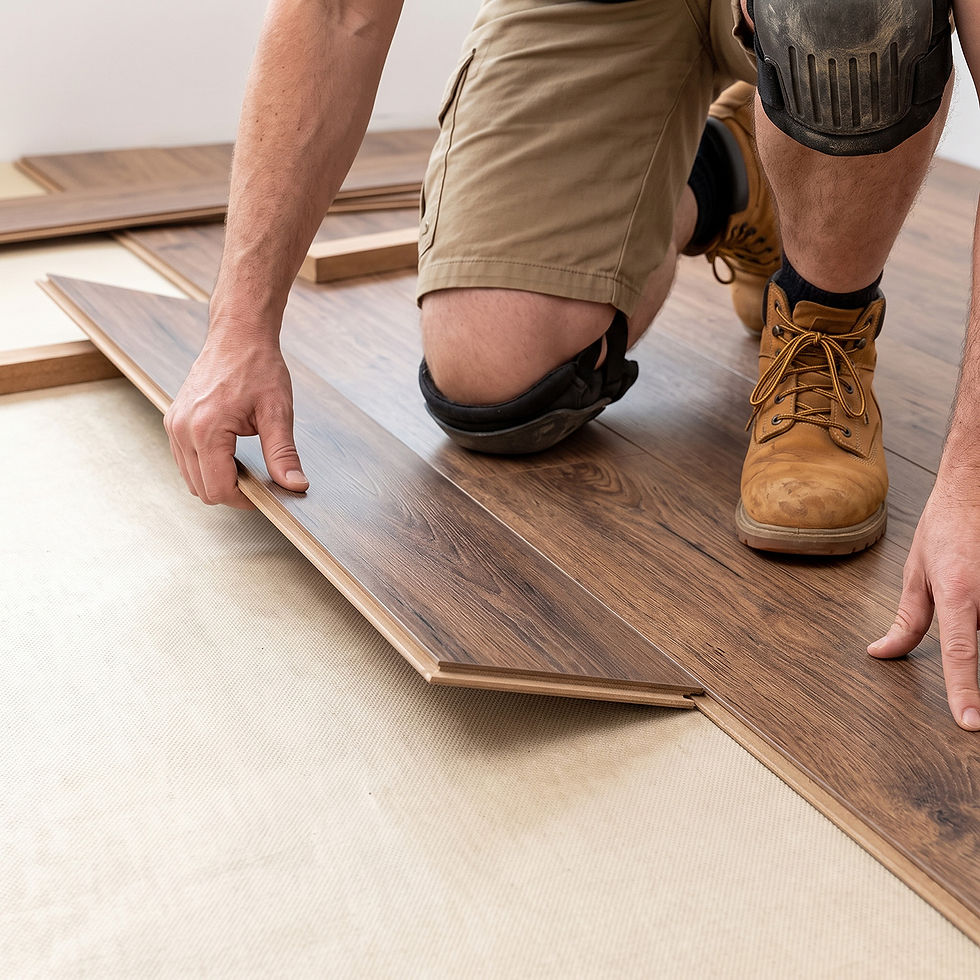
Floating Floor
An unbonded installation, laid over underlay rather than fixed to the substrate. A floating floor is quicker to install, softer and warmer underfoot, and can be laid over surfaces a bonded floor cannot.
The System
Boards join to one another rather than to the floor beneath, either by tongue and groove or by an interlocking profile. The underlay carries the floor and does much of the acoustic and thermal work.
Preparation
Levelling is paramount. Without a bonded connection to hold it, a floating floor follows any deviation in the substrate below, and expansion gaps must be allowed for at every perimeter and threshold.
Where it Applies
Suited to hybrid, laminate, engineered timber and similar products. Versatile across substrates, including existing tiled floors where a bonded system would not be viable.
Installation duration
Quicker to lay than a bonded floor, with no adhesive curing to allow for in the programme. Individual boards can also be lifted and replaced without disturbing the floor around them.
Sanding and refinishing
Softer underfoot than a bonded floor, and generally warmer. It reads less solid in use, which is a difference in character rather than a shortcoming. In most cases a floating floor cannot be sanded and refinished.

The System
The barrier, the adhesive and the board are specified to work together, not chosen separately. Product and system are matched to the substrate and the conditions beneath it.
Preparation
The slab must be sound, level and within moisture tolerance before any adhesive is laid. Assessment cannot be shortened, and remediation, where needed, comes first.
Where it Applies
Suited to engineered timber, solid timber, vinyl plank and bamboo. Laminate and hybrid are laid differently. Stairs are always direct stick, whatever the surrounding floor.
Installation duration
Preparation, adhesive curing and moisture testing each carry their own timeframes. A direct stick floor generally takes longer to lay than a floating one, and the programme should allow for it.
Sanding and refinishing
Where wear layer allows, a direct stick floor can be sanded and refinished rather than replaced. A permanent installation, but not a fixed one.
Direct Stick
A bonded installation, adhered directly to the substrate beneath it. Direct stick produces a floor that is solid underfoot, quiet in use and permanent, with the broadest range of finishes available to it.

Key Takeaways
Not all products are the same.
Not all products can be installed the same way
Install method varies cost.
The method of install will influence the cost
Floor preparation is essential
Floor preparation is essential regardless of method
Systems can determine finishes.
The system can determine the options for finishes
Stairs? Direct stick.
Stairs are always direct stick, never floating.
Neither system is "better".
No system is better it is determined by the project's needs
CHOOSING THE RIGHT FLOOR
THE WIDE WORLD OF FLOORBOARDS
Beneath the surface, flooring products differ more than they appear to. One is milled from a single piece of timber. Another is real timber over an engineered core. Others are manufactured entirely, built to reproduce the look of timber or stone on a board designed for stability rather than grain.
Construction determines behaviour. It governs how a board responds to moisture, whether it can be sanded and refinished, how it sounds and feels underfoot, how it is installed, and what it will look like in twenty years. A product that suits a coastal home may be the wrong choice for a bathroom, and a floor specified for a high traffic commercial fitout asks for different things again.
There is no single right answer, only the right answer for your project. What follows sets out how each type is made, what it does well, and where it is best placed.
Learn about our Products

Engineered Timber
Real timber, factory finished, over a stable engineered core. The veneer carries the grain and character of solid timber, while the layered construction beneath resists the movement that solid boards are prone to. It is the market's preferred choice, and for most projects it is the right one.
Veneer and coating are what matter.
The thickness of the wear layer determines how long a floor lasts and how many times it can be refinished. The factory applied coating determines how it holds up in the meantime.
Can be sanded and refinished.
Where the wear layer allows, an engineered floor can be brought back rather than replaced, which few manufactured products offer.
Installed floating or direct stick.
Available in tongue and groove or locking systems, which makes it the most versatile product across substrates and applications.
Stable,
but not inert.
The layered core resists movement far better than solid timber, though expansion still needs allowing for and some species remain less stable than others.
Hardness comes from both timber & core.
Janka ratings describe the species, not the board. A softer timber over a robust core still scratches and dents in daily use.
Grade and finish drive the range.
Selection, character and feature grades carry the same species at very different prices, and unfinished boards and Australian species extend the range well past what is held in stock.

Hybrid Timber Flooring
A manufactured product built for water resistance, pairing a vinyl surface with a solid core beneath. Waterproof through its construction rather than just its coating, hybrid is laid as a floating floor and suits areas where timber cannot go.
Waterproof throughout.
Water resistance is built into the core, not applied to the surface, which makes hybrid viable in bathrooms, laundries and other wet areas.
WPC and
SPC cores.
Wood plastic composite is softer and warmer underfoot, stone plastic composite is denser and more dimensionally stable. The choice follows the application.
Underlay is
attached.
Acoustic underlay comes bonded to the board, which simplifies installation and gives consistent performance across the floor.
Installed floating, with levelling paramount.
A glueless locking system laid over the substrate, which must be level, with expansion gaps allowed at every perimeter.
Timber and stone designs.
The range extends well beyond timber reproduction into tile and stone formats, with matching trims and accessories available across it.
Designs can
repeat.
Because the surface is printed, patterns recur across a floor at intervals set by the manufacturer. Worth understanding before specifying a large area.

Laminate Flooring
A manufactured product built around a printed decorative layer over a structural core, sealed beneath a hard wearing surface. Laminate offers the widest range of designs at the most accessible price, and is laid as a floating floor.
A printed surface, not a timber one.
The decorative layer reproduces timber grain photographically, protected by a wear layer that carries the durability rather than the appearance.
Durability
is rated.
AC ratings describe how the surface stands up to wear, and they track closely with price. Specifying to the traffic a floor will actually see is the practical decision.
Waterproof products are available.
Water resistance varies considerably across the range, so the specification matters more here than with hybrid, where it is built into the core.
Installed floating, with levelling paramount.
A glueless system laid over underlay, which is selected separately and does the acoustic and thermal work. Expansion gaps are required at every perimeter.
The widest range of designs.
Available in a broad selection of finishes and bevel treatments, generally in 8mm, with matching trims and accessories across the range.
Designs can
repeat.
The printed surface recurs at intervals set by the manufacturer, which is worth understanding before laying a large area.

Solid Timber Flooring
Traditional flooring, milled from a single piece of timber and finished on site rather than in a factory. Solid boards are laid direct stick and sanded and polished once down, producing a floor with no repeats, no veneer, and a finish made for the space it sits in. It is the most demanding product to work with and the most expensive, and for the right project it is worth both.
Finished on site, not in a factory.
Sanding and polishing happen after installation, which allows custom staining and a finish matched to the room. Samples are prepared before committing.
Always
direct stick.
Fixed to the substrate, other than plank on ply construction, and almost always tongue and groove.
Sanded and refinished to the tongue.
A solid floor can be brought back many times over its life, limited only by the depth of timber above the tongue.
Grade
drives cost.
Species and grade carry very different prices, and Janka ratings describe how each timber holds up underfoot.
Moisture content is critical.
Boards must be at the right moisture content before laying, and wider, thicker boards are generally more stable once down.
Increasingly
scarce.
Quality solid timber is harder to source than it once was, which affects both availability and lead time.

Underlays
The layer between a floating floor and the substrate beneath it. Underlay carries the acoustic performance of a floor, manages moisture from below, and evens out minor variation in the surface it sits on. It is rarely seen and easily undervalued, and it does more work than any other component of the installation.
Cork, foam and rubber.
Each performs differently across acoustics, comfort and resilience. The choice follows the product above it and the requirements of the building.
Acoustic rating is the spec that matters.
Where a building has acoustic requirements, particularly in multi residential, the underlay is what meets them. Ratings should be confirmed before the floor is ordered.
Moisture resistance from below.
A moisture resistant backing or plastic membrane protects the floor from vapour rising through the substrate, and is not optional over concrete.
Thickness is not the measure of quality.
A thicker underlay is not automatically a better one, and excess softness can affect how the locking system above it performs over time.
Some underlays are direct stick.
Bonded underlays are available where a floating installation is not suitable but acoustic separation is still required.
Quality is not the place to save.
The underlay outlasts nothing and supports everything. A floor is only as good as what sits beneath it, and this is the component most often compromised.
Yes samples are available, visit our showroom in Busselton or warehouses in Perth to see the complete range and choose a selection of samples to suit your requirements. Design professionals looking for sample libraries are encouraged to reach out directly. Our team can also provide in-home consultations by appointment.
Our engineered timber floorboards come in standard dimensions that we hold in stock locally. We can customise bespoke products to achieve the product you are looking for, with a longer lead time (4-5 months minimum). Please contact us for more information on custom options. Non-timber products such as laminate and hybrid cannot be customised at this stage but we offer several options to help you achieve the look you want.
Consider both design and practical needs. Start by assessing the aesthetic you want to achieve; scandi, rustic, contemporary, coastal etc and choose a colour, grade and finish that complements your style. Additionally, evaluate installation methods and maintenance requirements, as some finishes may need more upkeep than others. Finally, establish a budget to narrow options and request samples to see how different options look in your space before making a final decision.
We hold over 100 products locally and most stocklines are available at short notice, to be picked up in Perth or the South West within 1-2 days. For larger orders, delivery time may vary depending on stock availability (4-6 weeks), and custom orders require a 4-5 month lead time.
With years of industry experience across WA, our professional installation partner network is vast. We can match your desired timeframe, assuring quality and coordinating professional communication at all stages.
Absolutely! We work with a wide range of clients, including builders, home owners, architects, insurance and more. Additionally, we are on the panel of most major insurers and home builders. If you need some assistance, please contact our team.
Our directors have been in the industry for over 20 years with our General Manager having commenced his flooring career as an installer. We have built a network of floor professionals that we would be comfortable using in our friends' and families' homes. We're happy to discuss our process in detail and introduce you to our team.
Getting a quote is easy, simply contact our team via:
-
Email: sales@originflooring.com.au
-
Phone: 1300 382 033
-
We will likely need additional information from you such as plans or other specifications, so please have them handy.